Creating a calm homework space using Feng Shui: 10 simple ways to help your child stay focused
The next school year is fast approaching! My summer clients with children all ask me the same question which is, “how can i help my child stay focused this school year?” So i though i would share 10 simple ways, using Feng Shui, that you can copy too!
This summer has been a wild one for our family! Between a loved family member ending up in the hospital, working on a farm, summer birthdays, and road trips, i have barely been finding the time to get back to my blog!
But as the summer winds down and we start to think about falland back to school, i wanted to get right back to blogging so that i can help you through this transition.
Now, i homeschool my children, so Feng Shui is so important for our daily rhythms and routines but, you can also use and apply these tips to the area that your child studies and does their homework. I feel many parents are so focused on buying the right supplies, and sorting schedules, that often the environment in which their children learn is often overlooked.
A well designed homework space can make it easier for children to concentrate, stay organized, and feel less overwhelmed. It is also important to remember that you don’t need to renovate a room or buy expensive furniture to do this. Small, intentional changes can have a big impact.
Rather than viewing Feng Shui as superstition, think of it as designing a space that naturally supports healthy habits. Clear surfaces, comfortable seating, natural light, and a sense of order all contribute to better focus, it really is that simple!
Choose the right location
I always like to suggest choosing the place your child naturally likes to work in. This is because the space they choose is often where they feel the most safe and supported. If this happens to be the living room or games room, be sure that all TV’s are off and distractions are put away during homework time to create an energetic boundary.
If your child works in their bedroom, try to separate the study area from the sleeping area. This helps the brain associate the desk with learning and the bed with rest.
Position the desk for confidence
In almost every home that i have helped Feng Shui, children’s desks have been placed facing a wall. What this does is create creative blocks and makes it hard to concentrate.
The command position isn’t just important for adults, it is important for children too.
Whenever possible, position the desk so your child can see the door without sitting directly in line with it. Having a solid wall behind the chair can also create a feeling of security and support.
If moving the desk isn't possible, placing a small mirror where your child can see the doorway can help create a similar sense of awareness.
Declutter before you start
Clutter will always compete for attention. It is known that when a room is cluttered, it makes it harder to concentrate. Before studying or homework begins, spend a few minutes removing distractions and piles of clutter.
You probably find that when your home is cluttered you naturally feel more uncomfortable, and this is the same for children.
Use natural light
Natural light will improve mood and concentration. It will also help with eye strain.
Whenever possible:
Place a desk near a window
Make sure curtains are open
Add a soft but bright lamp if it is dark outside
Add nature
Adding nature, like plants, to your child’s work area will make the area feel more welcoming. In Feng Shui, plants represent vitality and growth.
Choose plants like:
Snake plants
A purple orchid
Pothos
If plants are not your thing you can add earth elements like terracotta pots, or images of nature.
Use calming colors
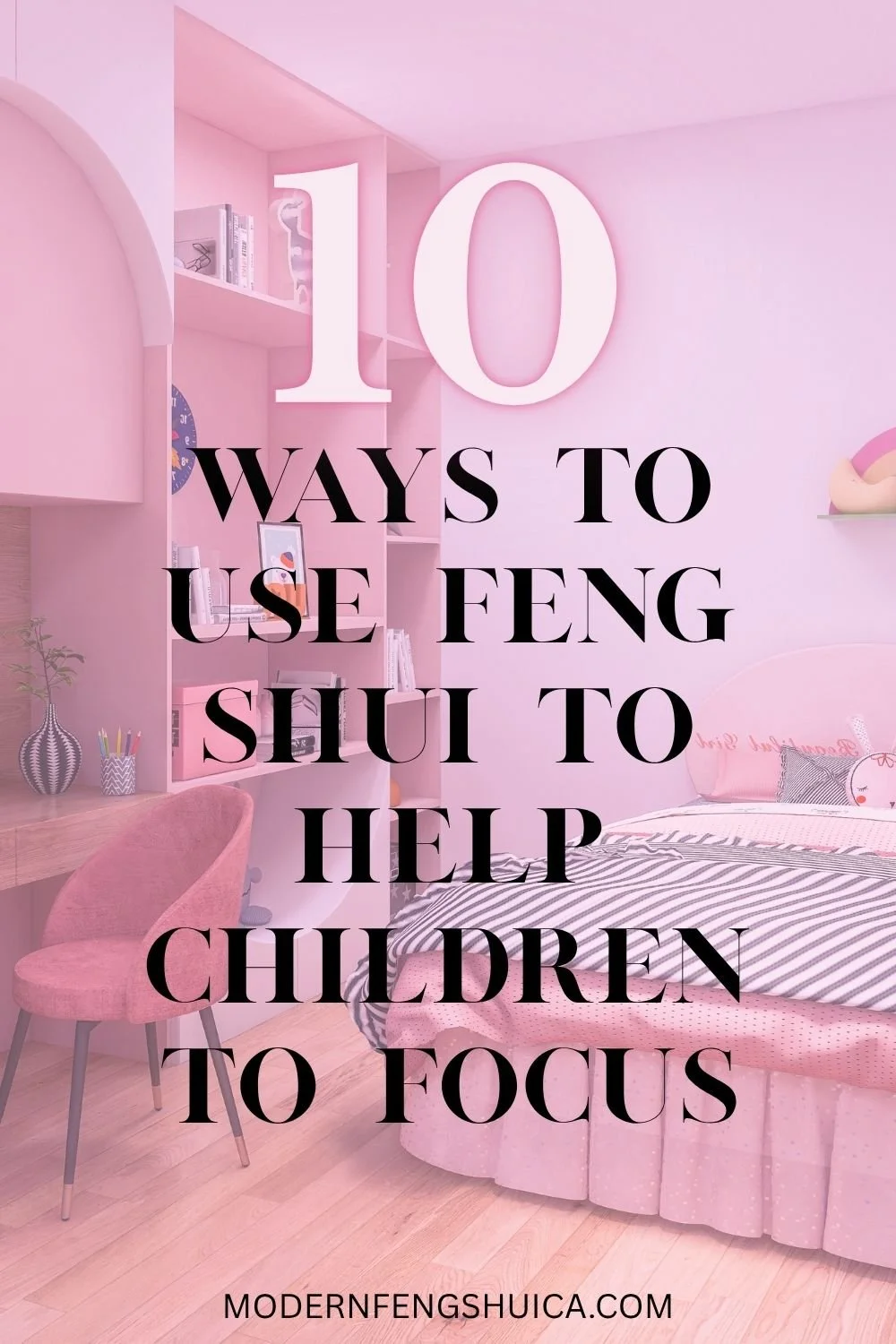
The colors you choose will heavily impact your child’s focus. If you decorate with bright, neon colors, you will find that your child will want to get up and leave and feel fidgety. This is also true for the colors you choose for your child’s bedroom. If the bedroom is too bright, they may be a bad sleeper.
For homework areas choose colors like; soft green, light blue, cream or off white, and beige.
Create smart storage
When your child’s books and homework is easy to find, it will make the transition to work time easier.
If you are shouting and your energy is heightened because you can’t find books etc. it will have an effect on your child’s energy. An organized environment also menas your mind will feel more organized.
Make sure homework and books are easy to find and access
Use baskets to organize supplies
Use file folders for worksheets
Keep the work area clear and organized
Personalize the space
Adding a something fun will make your child gravitate to the study space. This could be a picture of something they love, framed achievements to remind them how special and smart they are, or a corkboard with inspirational images or goals.
You could also let you child help pick out a piece of decor. If they feel happy in a space they will more likely want to stay there.
Choose seating to support
Whether your child studies or does homework at a desk on the dining room table, seating is very important.
A supportive chair will not only help posture, but a straight back will also help energy and focus. If you are slumped or feel uncomfortable, it will affect the outcome of your work.
Set a timer
Setting a timer is a game changer for my children! 20 focused minutes of homework will always be better than an hour of scattered studying.
Just be sure that the timer is out of sight so that they are not distracted by it.
I have found that setting a timer actually help my children remember more information as they are committed to learning in the time that they have been given. 20 to 30 minutes for each task is usually the most efficient.
If your child really struggles, offer a small reward. This will let them know that there is always something to look forward to.
Bonus tip: Sometimes a change in environment will help shift energy. There have been a few times that my children will sit down to do some learning and just feel ‘off’. Those are the days we pack up the workbooks and go outside to the garden, or a local park to read. 20 minutes of work followed by 20 minutes of playground time always seems to work!